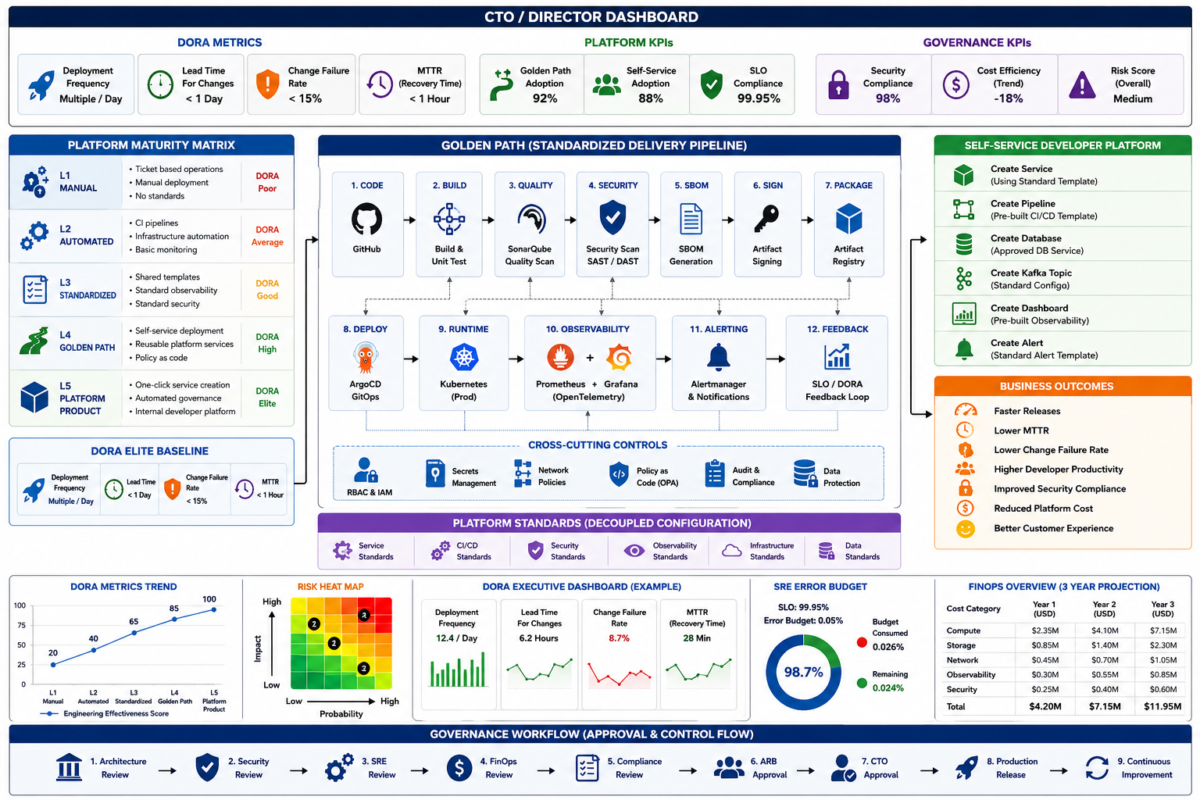
Architecture governance isn’t bureaucracy — it’s your competitive advantage
Without a governance model, technology decisions fragment, costs spiral, and reliability becomes an afterthought. Here’s how to build the framework that keeps Fortune 500-scale platforms predictable, secure, and fast.
Most engineering organizations discover they need architecture governance the hard way — after a major incident, a cost overrun that surprises the board, or a security breach that could have been caught upstream. By then, the patterns are already embedded in the codebase, the technical debt is compounding, and fixing it requires painful, expensive rework.
The organizations that get this right build governance into how they work before those moments arrive. Not as a gatekeeping function, but as a discipline that makes it easier — not harder — to ship good software reliably at scale.
Why governance is a business imperative, not just a technical one
The core job of architecture governance is to ensure that every technology decision advances business outcomes. That means faster time to market, predictable reliability, manageable risk, and transparent costs. When governance is absent or weak, all four break down simultaneously — and they tend to break down in ways that are invisible until they become catastrophic.
Consider what uncontrolled architectural drift produces: duplicate systems solving the same problem across business units, security controls that are inconsistent across services, cloud spend that nobody can explain at the team level, and outages that cascade because nobody mapped the failure modes in advance.
These aren’t aspirational numbers — they’re the measurable outcomes that a well-run Architecture Review Board (ARB) and standardized review process produce over time. The investment in governance pays back quickly, and it compounds as the organization scales.
The six principles that make governance work
Effective architecture governance rests on a small set of mandatory principles. These aren’t guidelines — they are the foundation on which every design decision is evaluated. Exceptions require CTO approval with documented risk acceptance.
The Architecture Review Board: scoring proposals, not blocking them
The ARB’s job is often misunderstood. It is not a committee that says no. It is a structured mechanism for surfacing risks early, when they are cheap to address, rather than late, when they are expensive. The scoring model is the key to making this work without slowing down engineering.
All architecture proposals are scored across nine weighted pillars totaling 100 points:
The approval thresholds are clear and non-negotiable:
What makes this system effective is that each pillar has a detailed rubric — not vague criteria, but specific, quantifiable thresholds. A score of 90–100 on scalability means horizontal scale has been proven via load test at 1.5× the Year 3 peak with the partition strategy documented. A score below 50 means there is a known scale ceiling below Year 1 requirements. That specificity removes subjectivity and makes the review process efficient.
The risks that governance is actually preventing
Framing governance as a positive process is important, but so is being clear about what it is defending against. These are the risks that materialize most predictably when governance is absent:
| Risk | Severity | Governance response |
|---|---|---|
| Capacity exhaustion Platform cannot absorb 10× volume growth |
Critical | 3-year capacity model, auto-scaling policies, load tests at 1.5× peak |
| Security breach Data exposure across tenant boundaries |
Critical | Zero-trust, mandatory pen testing, SOC 2 Type II audit program |
| Cost overrun Uncontrolled cloud spend with no visibility |
High | FinOps dashboards, budget alerts, mandatory unit cost targets per ARB submission |
| Vendor lock-in Over-dependence on a single cloud provider |
Moderate | Multi-cloud reference architectures, abstraction layers reviewed in ARB |
| Compliance failure Regulatory or contractual breach |
Critical | Compliance pillar in ARB scoring, data residency standards, immutable audit logs |
The end-to-end approval flow: governance that doesn’t slow you down
A governance process that takes months is not governance — it’s obstruction. The approval workflow is designed with hard SLAs at every gate, so teams know exactly where their proposal is and how long it will take.
Capacity planning: the discipline most teams ignore until it’s too late
Capacity planning is not a spreadsheet exercise you do once. It is a mandatory PRR gate, updated continuously. At scale, the numbers are unforgiving. A platform processing 500,000 notifications per minute at baseline must be designed to handle 25,000 transactions per second at peak (with a 3× burst multiplier). By Year 3, that same platform may need to sustain 500,000 TPS at peak.
Target utilization must not exceed 60% of maximum capacity at peak load. The capacity workbook must demonstrate growth assumptions with confidence intervals and load test results at 1.5× projected peak before any deployment approval is granted.
The teams that do this well treat capacity as a product requirement, not an infrastructure concern. They run load tests at 1.5× projected peak, document auto-scaling policies and limits, and update their 3-year forecast quarterly. The teams that skip this discover their architectural ceiling under production load — never a good time.
SRE governance: when error budgets drive culture
The SLO framework turns reliability from an aspiration into an engineering constraint. For a notification API with a 99.95% availability SLO, the monthly error budget is exactly 21.9 minutes of downtime. When that budget is exhausted, non-critical deployments freeze, an incident review is mandatory within 48 hours, and if a systemic design flaw is identified, the proposal goes back through architecture review.
This is what makes SRE governance powerful: it creates a direct feedback loop between architectural decisions and their operational consequences. Teams that ship poorly-designed services feel the error budget pressure immediately. Teams that invest in resilient design earn the deployment velocity to move faster.
Deployment frequency: multiple times per day. Lead time for changes: under 1 day. Change failure rate: below 15%. Mean time to recovery: under 1 hour. These are not aspirational — they are the measurable output of a mature governance and platform engineering model.
What good governance looks like at the executive level
The quarterly architecture scorecard presented to the CTO Council is the accountability mechanism that keeps governance from becoming a back-office function. Five dimensions, five targets, five weighted contributions to an overall platform health score:
These are the numbers a board can understand and hold leadership accountable for. They translate the complexity of a large-scale platform into five levers that connect engineering decisions to business outcomes.
The bottom line
Architecture governance is not overhead — it is what allows engineering organizations to move fast without breaking things at scale. The organizations that invest in it early build compounding advantages: lower rework costs, higher deployment frequency, predictable reliability, and transparent cost structures that hold up to board-level scrutiny.
The organizations that skip it eventually build it anyway — reactively, expensively, after incidents that were preventable. The choice is when to build it, not whether to build it.